
Building a Proforma

For a new small business, having accurate and realistic financial projections is essential for setting the stage for sustainable success.

They provide a clear picture of what the business needs to be able to function and grow, helping to guide strategic decisions about sales goals and timelines as well as securing necessary funding.
Write your awesome label here.
Building your dream

Vision to Reality

Imagine taking your innovative idea and translating it into a detailed financial plan. A proforma helps you visualize how your business will grow, from initial launch to scaling up. It’s your roadmap to turning dreams into reality!

Strategic Clarity
& Goal Setting

A proforma provides clarity on your business strategy. It helps you outline your revenue streams, cost structure, and profitability. You’ll gain a deep understanding of what drives your business and how to optimize for success.

Setting ambitious yet achievable goals is crucial for growth. Your proforma helps you set these goals and provides a clear path to reach them. It’s like having a GPS for your business journey!
Write your awesome label here.

Confidence Booster

Having a solid proforma boosts your confidence. You’ll know exactly where your business stands financially and what steps you need to take to achieve your goals. This confidence is contagious and can inspire your team and stakeholders.

Creating a proforma empowers you with knowledge and control over your business’s financial future. It’s a proactive step that puts you in the driver’s seat, ready to navigate the exciting road ahead.

Risk Management & Investor Magnet

A proforma helps you anticipate potential challenges and plan for them. By forecasting different scenarios, you can develop strategies to mitigate risks and ensure your business remains resilient in the face of uncertainties.

Investors love a well-prepared proforma. It shows them that you’re serious, prepared, and have a clear plan for their investment. With a compelling proforma, you can attract the right investors and secure the funding you need to bring your vision to life.
Write your awesome label here.

Performance Tracking

Once your business is up and running, your proforma becomes a powerful tool for tracking performance. You can compare actual results against your projections, making it easier to adjust your strategies and stay on course.
Lesson series

A pro forma financial statement is a projection of your business's financial performance based on certain assumptions.

Here’s a simplified example for a new small business, such as a coffee shop:
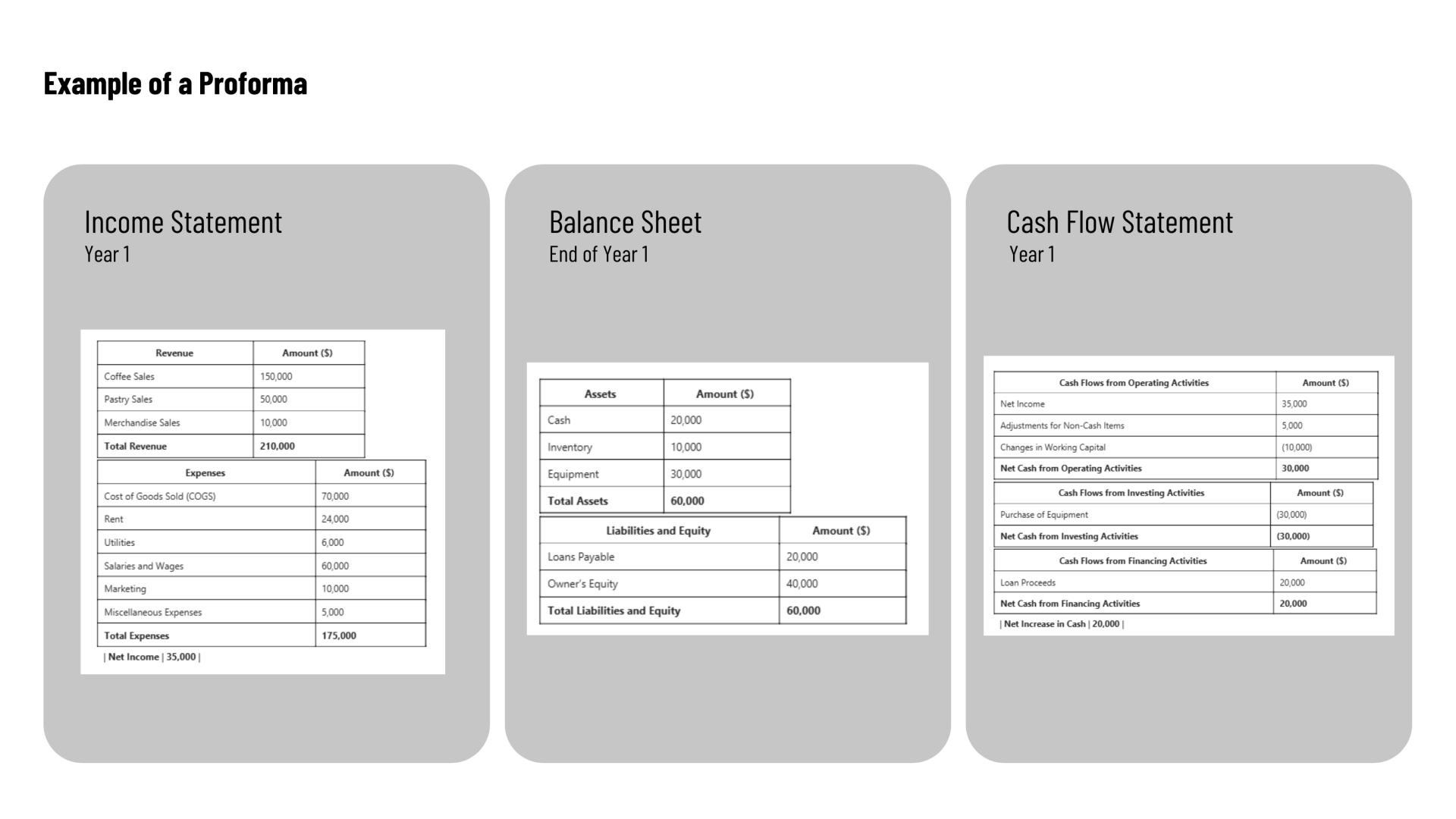
Here are some key assumptions made in the pro forma financial statements for the coffee shop:

Revenue Assumptions
  • Coffee Sales: Assumes an average of 100 cups sold per day at $4 each, operating 365 days a year.
  • Pastry Sales: Assumes an average of 50 pastries sold per day at $2.75 each.
  • Merchandise Sales: Assumes monthly sales of branded merchandise (mugs, t-shirts, etc.) totaling $10,000 annually.

Expense Assumptions
  • Cost of Goods Sold (COGS): Estimated at 33% of total revenue, covering the cost of coffee beans, pastries, and other consumables.
  • Rent: Assumes a monthly rent of $2,000.
  • Utilities: Estimated at $500 per month for electricity, water, and internet.
  • Salaries and Wages: Assumes 3 full-time employees with an average annual salary of $20,000 each.
  • Marketing: Budgeted at $10,000 annually for advertising, promotions, and social media campaigns.
  • Miscellaneous Expenses: Includes small expenses like office supplies, repairs, and maintenance, estimated at $5,000 annually.

Balance Sheet Assumptions
  • Cash: Initial cash balance of $20,000, reflecting the net increase in cash from the cash flow statement.
  • Inventory: Assumes an average inventory level of $10,000 for coffee beans, pastries, and merchandise.
  • Equipment: Includes the cost of coffee machines, furniture, and other equipment totaling $30,000.
  • Loans Payable: Assumes a business loan of $20,000 to cover initial setup costs.
  • Owner’s Equity: Reflects the owner's investment and retained earnings totaling $40,000.

Cash Flow Assumptions
  • Net Income: Derived from the pro forma income statement.
  • Adjustments for Non-Cash Items: Includes depreciation and other non-cash expenses estimated at $5,000.
  • Changes in Working Capital: Assumes a decrease in working capital of $10,000 due to initial inventory purchases.
  • Purchase of Equipment: Assumes a one-time purchase of equipment totaling $30,000.
  • Loan Proceeds: Assumes receipt of a $20,000 loan.

These assumptions are based on industry averages and typical costs for a small coffee shop. Adjustments may be needed based on specific business conditions and market research.

DIY

Here’s a step-by-step guide to help you create a comprehensive proforma:
Write your awesome label here.

1. Define Your Business Assumptions
Start by outlining the key assumptions for your business. These include:
  • Revenue Projections: Estimate your sales based on market research, industry trends, and your business model.
  • Cost of Goods Sold (COGS): Calculate the direct costs associated with producing your products or services.
  • Operating Expenses: Include rent, utilities, salaries, marketing, and other overhead costs.
  • Capital Expenditures: Plan for any major purchases like equipment or property.
  • Financing Assumptions: Determine how much funding you need and the sources (e.g., loans, equity).
2. Create a Pro Forma Income Statement
This statement projects your revenue, expenses, and net income over a specific period (usually monthly or annually).
3. Develop a Pro Forma Balance Sheet
This statement provides a snapshot of your business’s financial position at a specific point in time, showing assets, liabilities, and equity.
4. Prepare a Pro Forma Cash Flow Statement
This statement projects the cash inflows and outflows over a specific period, helping you manage liquidity.
5. Review and Adjust
Regularly review your proforma and adjust your assumptions based on actual performance and changing market conditions. This will help you stay on track and make informed decisions.
6. Use a Template or Financial Software
Consider using financial software or templates to streamline the process and ensure accuracy. Tools like Excel, QuickBooks, or specialized proforma software can be very helpful.